
Vacuum Lifters for Boxes
Vacuum lifters for bags provide an ergonomic and efficient solution for lifting, moving and positioning sacks and flexible packaged materials in production, processing and palletizing operations. Instead of repeatedly lifting bags manually, the operator uses vacuum assistance to grip the load and guide it between pickup and placement positions with significantly less physical effort.
Adria Manipulators provides vacuum tube lifting solutions for paper sacks, plastic bags and other flexible packaged loads. Each application is evaluated according to the actual bag weight, dimensions, packaging material, surface characteristics, porosity, handling frequency and workplace layout.
Unlike rigid cartons, bags can deform while being lifted. Their surfaces may also be porous, dusty, wrinkled or irregular. For this reason, selecting vacuum lifters for bags requires more than simply matching the lifting capacity to the weight of the load. The suction head, vacuum generation, lifting tube, support system and complete handling cycle must work together as one solution.
If operators repeatedly move bags between pallets, conveyors, filling lines, processing machines or workstations, the right vacuum bag lifter can make the process more ergonomic, controlled and efficient.
Why Use Vacuum Lifters for Bags?
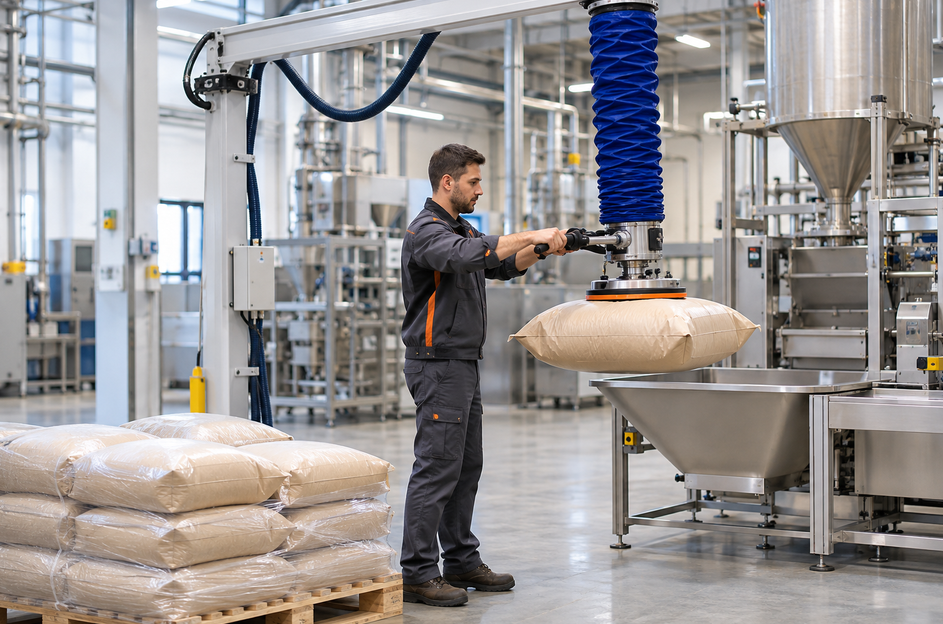
Manual bag handling is common in food production, agriculture, chemical processing, construction materials, packaging and many other industrial environments. Although an individual sack may appear manageable, repeatedly lifting and repositioning bags throughout a working shift can place considerable physical demands on operators.
The challenge is not limited to weight. Bags can be difficult to grip because they deform, sag or change shape when lifted. Operators may also need to reach across pallets, work close to floor level or move loads between different working heights.
Vacuum lifters for bags transfer much of the lifting effort from the operator to the vacuum lifting system. The operator remains in control of the movement but does not need to manually carry the full load through every lifting cycle.
Typical benefits include:
- Reduced physical effort during repetitive bag handling tasks.
- Improved workplace ergonomics when sacks are moved between different working heights.
- Controlled load movement between pickup and placement positions.
- More consistent repetitive handling during palletizing and depalletizing processes.
- Application-specific gripping for different bag surfaces and packaging materials.
- Integration into existing workflows such as production lines, packing stations and material handling areas.
Request a Tailored Bag Lifting Solution →
Where Are Vacuum Bag Lifters Used?
A vacuum bag lifter is particularly useful when sacks or flexible packages are moved repeatedly as part of an established production or logistics process.
The objective is not simply to lift a bag from the floor. A complete lifting solution should support the entire movement from the pickup position to the final destination.
Palletizing and Depalletizing Bags
Moving sacks between pallets and conveyors, filling lines or production equipment often requires operators to work at continuously changing heights.
At the beginning of a depalletizing process, bags may be positioned relatively high. As the pallet is emptied, the operator must progressively reach lower. The opposite happens during palletizing.
A vacuum lifting system allows the operator to grip the sack, raise it and guide it through the required movement while the lifting tube supports the load.
Loading Production and Processing Equipment
Many industrial processes use raw materials supplied in bags. Ingredients, powders, granulates or other materials may need to be transferred from pallets toward mixers, hoppers, processing equipment or preparation stations.
Vacuum lifters for bags can support this transfer by reducing the need for operators to manually carry the entire weight of each sack between the pallet and processing point.
End-of-Line Bag Handling
After filling or packaging, sacks often need to be removed from a conveyor and placed onto pallets. When this movement is performed repeatedly, a vacuum lifter can support a more ergonomic and consistent workflow.
The lifting system can become part of the end-of-line process rather than a separate manual operation.
Production and Packaging Lines
Vacuum tube lifters can also be used where bags need to move between machines, conveyors, pallets and inspection or packaging stations.
The required reach, lifting height and movement path should be evaluated together with the characteristics of the bag itself.
Vacuum Lifters for Bags and Porous Packaging
The surface of the load is one of the most important factors when selecting vacuum lifters for bags.
A bag is not a rigid workpiece. It can deform under vacuum, change shape while being moved and create an uneven contact area below the suction head.
Paper sacks can introduce an additional challenge because the packaging material may be porous. Air can continuously pass through the surface, meaning that the vacuum system must compensate for leakage while maintaining reliable contact with the load.
Plastic bags behave differently. Their material may be considerably less porous, but the flexible surface can wrinkle, fold or move as vacuum is applied.
Filled bags can also have different shapes depending on their contents.
Important factors when evaluating a bag lifting application therefore include:
- bag weight;
- minimum and maximum dimensions;
- paper, plastic or laminated packaging;
- surface porosity;
- surface contamination or dust;
- seams and closure areas;
- wrinkles and folds;
- bag flexibility;
- material contained inside the bag;
- available gripping area;
- handling frequency;
- required lifting height and reach.
For porous and flexible loads in particular, the lifting solution should be evaluated using representative packaging rather than assuming that all sacks with similar dimensions will behave in the same way.
Choosing the Right Suction Head for Bag Handling
The suction head is the physical interface between the vacuum lifting system and the bag. Its ability to establish and maintain suitable contact therefore plays a critical role in the complete application.
With a rigid object, the contact surface is relatively predictable. Flexible packaging behaves differently because the bag itself can move toward the suction head as vacuum is created.
A bag handling solution may therefore need to accommodate:
- soft and flexible surfaces;
- variable bag shapes;
- porous packaging materials;
- wrinkles and folds;
- dusty surfaces;
- different bag sizes within the same process.
The geometry and sealing properties of the suction head should therefore be selected according to the actual load.
This is particularly important for operations handling several bag formats at the same workstation. A solution that works well with one package should not automatically be assumed to work equally well with another.
For additional technical information, see our guide to handling porous loads with vacuum tube lifters.
Why Vacuum Flow Matters When Lifting Paper Sacks
One of the important technical differences between sealed loads and porous sacks is continuous air leakage.
When the suction head grips an airtight surface, the vacuum system establishes and maintains the required pressure difference. With porous materials, air may continuously enter through the packaging.
The vacuum source must therefore provide sufficient airflow to compensate for this leakage while maintaining stable lifting conditions.
This is why choosing vacuum lifters for bags based only on maximum lifting capacity can be misleading. Packaging characteristics need to be considered together with load weight.
The same principle applies if bags become dusty, if packaging materials change or if seams and folds vary between products.
Testing or evaluating representative loads helps determine a suitable suction and vacuum concept before the final configuration is defined.
Bag Handling Equipment Should Match the Complete Workflow
Effective bag handling equipment should be designed around the entire handling cycle rather than only around the load itself.
Consider an operator moving sacks from a pallet to a processing machine. The weight may remain approximately the same during every cycle, but the pickup height changes as the pallet is emptied.
The equipment must therefore accommodate both the load and the movement.
1. The Bag
- minimum and maximum weight;
- bag dimensions;
- packaging material;
- surface porosity;
- surface condition;
- rigidity or flexibility;
- bag contents;
- available gripping area.
2. The Required Movement
- pickup position;
- placement position;
- vertical lifting distance;
- horizontal movement;
- required positioning or orientation;
- handling frequency.
3. The Workplace
- available floor space;
- ceiling height;
- required working radius;
- position of machinery;
- position of conveyors and pallets;
- obstacles within the working area;
- specific environmental requirements.
Considering these factors allows the lifting system to support the actual workflow instead of forcing the operator to adapt the production process to unsuitable equipment.
Vacuum Lifters for Bags in Food Production
Bag handling is particularly common in food and ingredient processing, where raw materials are frequently supplied in sacks and need to be transferred between pallets, preparation areas and processing equipment.
Depending on the application, operators may handle flour, sugar, starch, grains or other ingredients packaged in paper or plastic bags.
A vacuum bag lifter can support the physical transfer of these loads from a pallet toward a workstation, hopper or processing point.
Where hygienic requirements are important, equipment materials and system configuration should also be considered during application planning.
Adria Manipulators offers Tube Lifter configurations for different industrial environments, including stainless-steel options on selected systems for applications where material selection and hygiene requirements are particularly relevant.
Vacuum Sack Lifters for Industrial Materials
Sacks are also widely used for powders, granulates and other industrial materials.
These packages may be flexible, heavy, dusty or difficult for an operator to grip consistently by hand.
A vacuum sack lifter can assist with transferring individual sacks between pallets, conveyors and workstations while reducing the physical effort required from the operator.
Dust and surface contamination should be taken into account during system selection. They can affect the interaction between the suction head and packaging and may also influence filtration and maintenance considerations.
The application should therefore be evaluated as a complete lifting system rather than simply as a question of maximum load capacity.
Which Vacuum Tube Lifter Is Suitable for Bags?
There is no single Tube Lifter configuration that is automatically suitable for every bag-handling application.
The correct solution depends on the bag, the required movement and the workplace.
The AG033 Tube Lifter, for example, is designed for applications that include sack handling, box lifting and palletizing. Other models within the Tube Lifter range provide different combinations of lifting capacity, reach and working configuration.
The final selection should consider:
- bag weight and dimensions;
- surface porosity;
- required suction head;
- lifting frequency;
- horizontal reach;
- available installation space;
- working height;
- production environment.
You therefore do not need to select a specific model before contacting Adria Manipulators.
Start with your bags and your handling process. The lifting system can then be selected and configured around those requirements.
From the Bag to a Complete Vacuum Lifting Solution
A vacuum lifting application involves more than the lifting tube itself.
Depending on the application, a complete solution can include:
- vacuum generation;
- lifting tube;
- control handle;
- suction or gripping head;
- hoses;
- filtration;
- support system;
- required horizontal working range.
The support system is particularly important because it determines how the operator can move the load through the working area.
The Tube Lifter can be combined with an appropriate supporting structure according to the required reach, workstation layout and production process.
This system-level approach allows vacuum lifters for bags to become part of the complete material handling workflow rather than simply acting as standalone lifting equipment.
What Information Do We Need for Your Bag Lifting Application?
You do not need to prepare a complete technical specification before contacting Adria Manipulators.
A few practical details are usually sufficient for an initial evaluation:
- Bag weight – including minimum and maximum weights when several products are handled.
- Bag dimensions – approximate length, width and height.
- Packaging material – paper, plastic, laminated material or another type.
- Surface condition – including whether the packaging is porous, dusty or irregular.
- Photos of the bags – preferably showing the surface available for gripping.
- Pickup position – for example from a pallet or conveyor.
- Placement position – such as a machine, hopper, conveyor or pallet.
- Handling frequency – how often the lifting cycle is repeated.
- Workspace information – particularly required reach and available height.
These details help define both the vacuum gripping requirements and the overall workstation configuration.
Why Choose Adria Manipulators for Vacuum Bag Handling?
Adria Manipulators approaches bag lifting as a complete material handling application rather than simply matching a specified load weight with a lifting device.
The bag surface, packaging porosity, deformation, suction head, vacuum system, movement path and workstation all influence the final solution.
This approach is particularly important with flexible loads because two sacks with a similar weight can behave very differently depending on their packaging material and contents.
A paper sack containing powder, for example, presents different gripping conditions from a sealed plastic bag containing granulated material.
By evaluating the real load and working process, the system can be configured around what the operator actually needs to do: pick up the bag, move it through the required working area and place it at the destination with reduced manual lifting effort.
Request Vacuum Lifters for Bags
Are your operators still lifting bags manually?
Send Adria Manipulators information about your load and handling process and let our team evaluate a suitable vacuum lifting solution.
You do not need to know which Tube Lifter model or suction head you require. Tell us what type of bags you handle, their weight and dimensions, what the packaging is made from and how the loads need to be moved.
Photos of the bags and workstation are especially useful for understanding the application.
Request a Tailored Bag Lifting Solution →
Adria Manipulators can help you identify vacuum lifters for bags configured around your packaging, production process and working environment.
AG033 – Fast and Safe Vacuum Lifting for Bags
AG033 – Tube Lifter for Porous Cardboard Boxes sealed with Tape
FAQ: Vacuum Lifters for Bags
What are vacuum lifters for bags?
Vacuum lifters for bags are lifting systems that use vacuum to grip a sack or flexible package while the lifting tube supports the load. The operator controls and guides the movement without manually carrying the full weight of the bag.
Can vacuum lifters handle paper sacks?
Yes, depending on the packaging and system configuration. Paper sacks can be porous, which creates continuous air leakage. The vacuum source and suction head therefore need to be selected according to the actual packaging.
Can a vacuum bag lifter handle plastic bags?
Yes, depending on the application. Plastic bags may be less porous than paper sacks but can deform, wrinkle or change shape during lifting. The gripping solution must therefore be suitable for the actual bag surface.
Why are porous bags more difficult to lift with vacuum?
Porous packaging allows air to pass through the material. The vacuum system needs to compensate for this leakage while maintaining sufficient contact between the suction head and the bag.
Can one vacuum lifter handle different bag sizes?
Potentially, yes. Suitability depends on differences in weight, dimensions, packaging material, surface condition and available gripping area. The complete range of bags should be evaluated before selecting the final configuration.
Where are vacuum sack lifters typically used?
Common applications include palletizing, depalletizing, food and ingredient handling, production lines, packaging processes and industrial environments where sacks are moved repeatedly.
Which vacuum lifter do I need for my bags?
The correct configuration depends on bag weight, dimensions, packaging material, porosity, handling frequency, required reach and workplace layout. Adria Manipulators can evaluate these factors and recommend a suitable solution.
What information should I send when requesting a quotation?
Send the minimum and maximum bag weight, dimensions, packaging material, photos of the bags, pickup and placement positions, handling frequency and basic information about the available workspace.
Find the Right Vacuum Lifter for Your Bags
Send us your bag specifications and let us evaluate your application.
Tell us the weight and dimensions of your bags, packaging material, surface characteristics, handling frequency and where the loads need to be moved.
Add photos of the bags and workstation to help our team better understand your handling process.
You do not need to select the Tube Lifter model or suction head yourself.