Manual Vacuum Tube Lifter for Rapid Order Picking: Smarter Than Full Automation (2026)
January 30, 2026
Vacuum Tube Lifters for Safer Material Handling
April 30, 2026
Case Study • Updated for modern warehouse operations (2026-ready)
Optimizing Warehouse Efficiency: A Comprehensive Case Study on Ergonomic Lifting Solutions for Heavy Carton Handling
Distribution centers are under relentless pressure to increase throughput while protecting margins and workforce health. For many operations, the biggest bottleneck isn’t software or storage—it’s manual load handling at high-frequency packing and shipping stations. This case study shows how a regional distributor of automotive spare parts improved performance and safety by implementing ergonomic lifting solutions based on a high-capacity vacuum tube lifter system.
While robotic palletizers often dominate headlines, real warehouse floors involve mixed SKUs, variable cartons, and unpredictable sequences. In such conditions, a human-centric approach—powered by vacuum technology—can outperform rigid automation in speed, flexibility, and ROI.
Summary (What changed, fast)
- Problem: Heavy cartons (15–35 kg), 300+ lifts per shift per operator, fatigue-driven productivity drop.
- Decision: Avoid rigid automation due to carton variability and complex vision/programming requirements.
- Solution: Vacuum tube lifter + overhead crane + specialized suction tooling for porous cardboard.
- Outcome: +40% throughput, zero ergonomic injury reports in the department, reduced product damage, improved retention.
Table of Contents
- The Challenge: Manual Handling and the Productivity Bottleneck
- The Proposed Solution: Bridging the Gap Between Human and Machine
- Implementation Process: Seamless Integration
- Measured Results and ROI
- Blueprint: How to Replicate This in Your Warehouse
- Choosing the Right Model for Heavy Carton Handling
- FAQ
1) The Challenge: Manual Handling and the Productivity Bottleneck
The client operated a massive central warehouse with a severe bottleneck in the outbound shipping sector. The core issue was the repetitive manual handling of heavy carton boxes containing diverse automotive components.

The physical toll on the workforce
The facility processed thousands of orders daily. In the department under review, a single operative had to lift, rotate, and palletize over 300 cardboard boxes per shift. Package weight varied between 15 and 35 kg, combined with frequent bending, twisting, and reaching—classic risk factors for musculoskeletal disorders (MSDs).
Over time, the warehouse experienced compounding issues:
- Ergonomic risk & MSDs: Increased sick leave and compensation claims linked to fatigue and injury.
- Afternoon productivity slump: Time studies showed a clear throughput drop in the second half of the shift.
- High employee turnover: Physically demanding roles are harder to staff and retain—driving continuous hiring/training costs.
- Product damage: Fatigue reduced grip stability, leading to occasional drops and damaged goods.
The requirement was clear: reduce physical burden, stabilize output across the entire shift, and handle variable carton sizes and weights without disrupting shipping schedules.
2) The Proposed Ergonomic Lifting Solutions: Bridging the Gap Between Human and Machine
After an operational audit, a fully automated robotic cell was deemed economically and practically unsuitable. The variety of cartons and unpredictable order sequences would require complex vision systems and frequent reconfiguration, extending ROI beyond acceptable limits.
Instead, the strategy focused on empowering operators with affordable pneumatic force using vacuum technology—keeping the agility of human decision-making while eliminating the heavy lifting.
Selecting the right technology
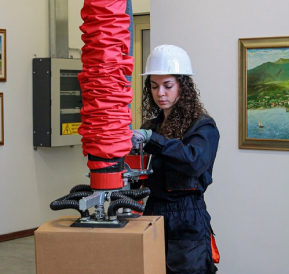
Vacuum lifting offers a fast and adaptable method for handling cartons without clamps or mechanical grippers that can crush packaging. A properly sized vacuum tube lifter makes the load feel nearly weightless, turning the operator’s role into guidance and positioning instead of physical exertion.
Handling porous industrial cardboard: the suction tooling detail that matters
Standard suction cups can struggle on porous carton surfaces due to micro-leakage. The solution used a high-flow, dual-head suction attachment with soft, deep sealing lips to compensate for carton deformation and maintain stable grip, even on variable textures.
3) Implementation Process: Seamless Integration
The client required minimal disruption to daily quotas. The entire installation was planned and executed over a single weekend, allowing normal shipping operations to resume immediately.
ergonomic lifting solutions - Structural and mechanical setup
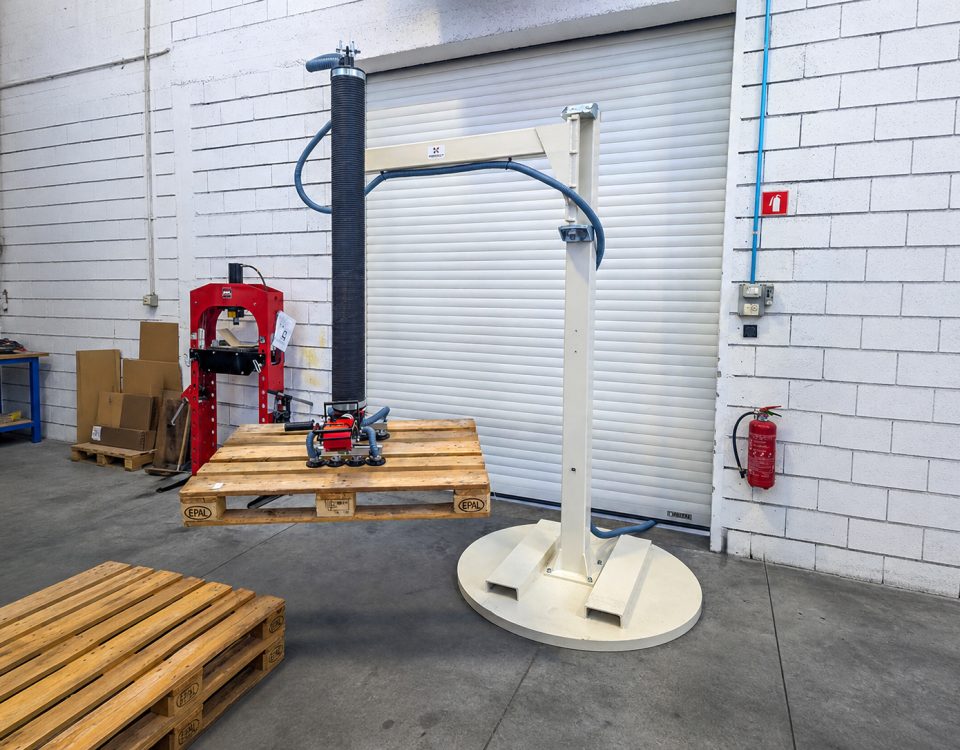
The workstation was built around a lightweight, low-friction aluminum overhead crane system. This enabled smooth X/Y movement across the packing zone with minimal rolling resistance—operators could reposition loads with a gentle push.
Suspended from the crane: a responsive vacuum hoist with an ergonomic handle and proportional control. This allowed precise lifting and lowering based on operator input, improving placement accuracy and pallet stability.
Power and efficiency: Venturi ejector vacuum generation
The vacuum force was generated using a Venturi ejector system powered by compressed air. This approach provided immediate grip-and-release response—critical for high-volume pick-and-place cycles—and reduced maintenance complexity thanks to the absence of moving pump parts.
Workforce training and adoption
Adoption was fast. Operators were trained in a short session (around 30 minutes) covering engagement, control behavior, safe release, and basic daily checks. The result: quick acceptance with minimal learning curve.
4) Measurable Results and Return on Investment (ROI)
Three months post-implementation, the distribution center reported strong performance improvements and substantial safety benefits. The biggest change was the elimination of fatigue-driven slowdown—output remained stable from the first hour to the last.
Before vs After (key metrics)
- Throughput: 300 → 420 boxes palletized per operator per shift (+40%)
- Ergonomic incidents: Reported zero lower-back pain / strain incidents in the department post-commissioning
- Product damage: Drops and damage events significantly reduced due to stable vacuum grip and controlled descent
- Retention: Employee turnover reported down by 60%+ in the first quarter after installation
- ROI: Payback estimate improved from ~2 years to < 8 months based on throughput + reduced downtime
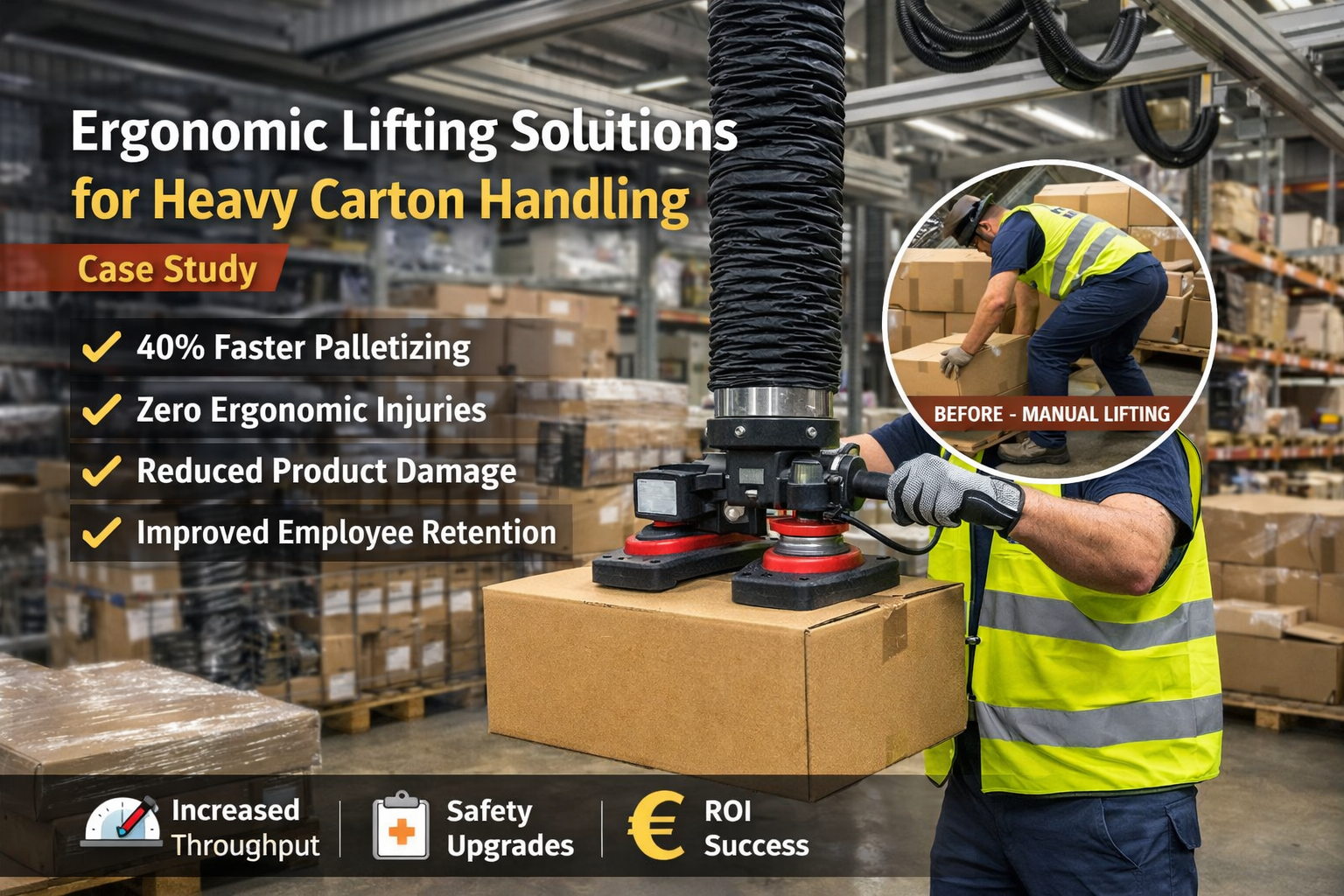
The operator’s perspective
“We thought the machine would slow us down. We couldn’t have been more wrong. The operator is essentially just guiding the lifter through the air. The workflow stays fast from the first hour to the last—and we haven’t had a single injury report in months.”
The core lesson: ergonomic lifting solutions aren’t just safety upgrades—they are throughput stabilizers and cost-control tools.
5) Blueprint: How to Replicate ergonomic lifting solutions in Your Warehouse
Step 1: Identify the station-level bottleneck
- Where does output drop late in the shift?
- Which station has the highest lift frequency?
- Which loads exceed 15 kg repeatedly or require twisting/reaching?
Step 2: Use this sizing checklist before procurement
- Load weight: max + typical weight range (include margin)
- Surface: porous cartons vs smooth packaging (tooling choice is critical)
- Lift frequency: cycles per hour and per shift
- Headroom & reach: ceiling height, rack depth, pallet zones
- Mounting concept: overhead rail, jib crane, column, or bridge
- Operator flow: minimize walking distance and unnecessary re-grips
Step 3: Standardize daily checks
To keep performance consistent, standardize quick daily inspection routines (pads/seals, filters, compressed air supply, control behavior), and train operators on correct pick points for each carton type.
6) Choosing the Right Model for Heavy Carton Handling (AG Series)
For warehouse and distribution use cases, the best model choice depends on load range, station geometry, and required reach. Two common starting points:
- AG033: ideal for general warehouse picking and fast handling of mixed cartons where flexibility matters.
- AG044: designed for heavier cartons and dense loads, offering robust capacity and extended reach for demanding pallet zones.
If you want a fast selection path: start from the heaviest routine box, then confirm reach/headroom, then finalize suction tooling for carton porosity.
FAQ
Why not use a robotic palletizer for mixed carton handling?
When cartons vary in size, weight, sequence, and surface behavior, robotic systems often need advanced vision, reconfiguration, and exception handling—adding cost and commissioning time. Vacuum assistance keeps agility while solving fatigue and safety issues.
Do vacuum tube lifters work on porous cartons?
Yes—if properly configured. Porous cardboard typically needs high-flow vacuum generation and suction tooling designed to maintain sealing despite micro-leakage and carton deformation.
How quickly can operators learn the system?
Most ergonomic vacuum lifters are designed for intuitive use. Training often focuses on correct pickup points, proportional control, safe release, and daily inspection routines.
What’s the fastest way to select between AG033 and AG044?
Use AG033 for speed and flexibility in mixed picking. Choose AG044 for heavier loads and larger pallet zones.
Note: This case study is informational and reflects reported operational results. Final outcomes depend on load profiles, station layout, and configuration.
See Our Tube Lifters in Action
Want to see how our vacuum lifters operate in real industrial environments?
Visit our YouTube channel for demo videos, installations, and expert insights.
Ready to Improve Box and Bag Handling?
Our engineers can review your loads (weight, dimensions, surface) and recommend a vacuum lifting system tailored to your line speed and ceiling height.
Contact the TubeLifters service team for guidance, spare parts, or on-site training.