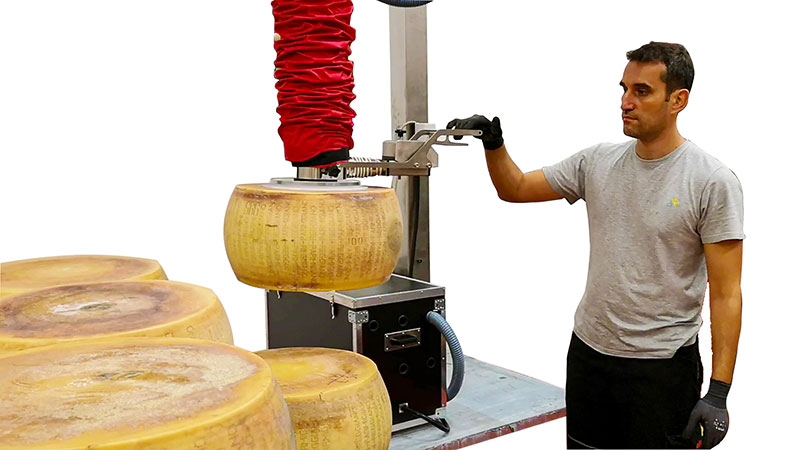
Precision and Hygiene in Dairy Logistics: Ergonomic Handling of Heavy Cheese Wheels
May 21, 2026
In modern manufacturing, logistics and packaging environments, time is directly tied to productivity and profitability. Production managers, warehouse supervisors and process engineers are constantly looking for ways to improve throughput without compromising operator safety. When companies evaluate ergonomic handling equipment, one of the most common technical questions is: what is the maximum lifting speed of vacuum tube lifters?
Unlike traditional chain hoists or winches that operate at fixed motorized speeds, a vacuum tube lifter is a dynamic, operator-controlled lifting system. Its performance depends not only on vertical lifting speed, but also on gripping time, load characteristics, vacuum flow, operator movement and the total handling cycle. To understand how fast these systems can actually work, it is important to look beyond one single speed value.
What is the Maximum Lifting Speed of Vacuum Tube Lifters?
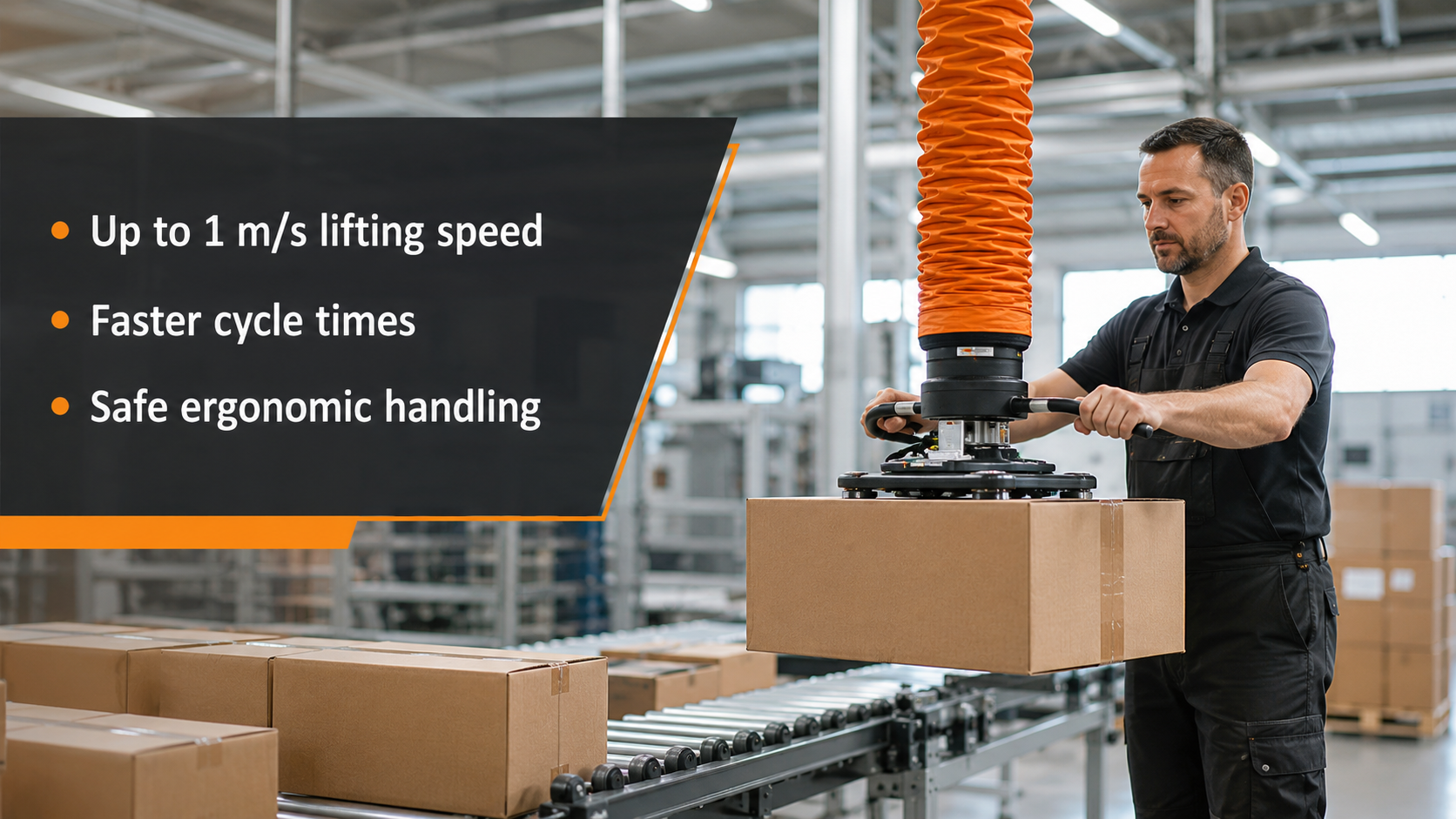
Under optimal conditions, the maximum lifting speed of vacuum tube lifters can reach up to approximately 1 meter per second, which equals around 60 meters per minute. This makes vacuum tube lifters significantly faster in practical handling operations than many conventional lifting devices used in production and warehouse environments.
However, in real industrial applications, raw vertical lifting speed is rarely the only metric that matters. Companies usually focus on the complete handling cycle: how long it takes to grip the product, lift it, move it to the required position and release it safely. In this sense, vacuum tube lifters often deliver their greatest advantage because they eliminate slow manual steps such as attaching hooks, chains, straps or slings.
Instead of preparing the load before every lift, the operator simply positions the suction cup on the product, activates the vacuum and lifts the load in one continuous motion. This can reduce cycle times dramatically, especially in repetitive handling tasks such as palletizing, depalletizing, sorting, packaging and end-of-line production processes.
Why Cycle Time Matters More Than Raw Lifting Speed
When comparing different industrial lifting solutions, it is tempting to focus only on vertical lifting speed. But in daily production, the total process time is much more important. A lifting device may have a fast motorized movement, but if the operator needs extra time to attach the load, secure it, align it and release it, the overall process can still be slow.
A vacuum tube lifter improves cycle time because gripping and lifting happen almost instantly. The suction cup attaches to the surface of the load, the lifting tube contracts and the product can be moved without excessive physical effort. This creates a faster, smoother and more natural handling rhythm for the operator.
For many companies, the practical benefit is not only faster lifting, but also more consistent work performance during the entire shift. Because the operator is not manually carrying or straining under the load, fatigue is reduced. This helps maintain productivity, accuracy and workplace safety over longer periods of repetitive handling.
Key Factors That Determine Lifting Speed
Although vacuum tube lifters can achieve very high lifting speeds, the real operational speed depends on several technical and practical factors. The system must be properly configured for the type of load, working environment and required handling frequency.
1. Vacuum Flow and Pump Capacity
The vacuum pump is the heart of every vacuum lifting system. It generates the vacuum flow required to grip the load and contract the lifting tube. A high-capacity pump allows the system to create suction quickly and respond immediately to operator control.
If the pump is undersized for the application, the lifting movement can feel slow or unstable. This is especially important when handling porous materials or products with uneven surfaces. Correctly sizing the vacuum generator ensures that the lifter reacts quickly, maintains a secure grip and supports efficient handling speed throughout the process.
2. Porosity of the Load
The material and surface of the load have a major impact on lifting speed. Non-porous materials such as sheet metal, glass, plastic containers or smooth panels usually allow the suction cup to create an airtight seal very quickly. This enables fast vacuum build-up and high lifting performance.
Porous materials such as cardboard boxes, paper sacks, wooden boards or textile bags allow air to leak through the surface. In these cases, the vacuum pump must continuously compensate for air leakage. To maintain high lifting speeds with porous loads, the system often requires a higher-flow vacuum pump and a suction cup design adapted to the product.
3. Load Weight and System Capacity
The relationship between the weight of the load and the rated capacity of the lifter also affects speed. A 10 kg box handled by a lifter designed for 50 kg will move quickly and effortlessly. On the other hand, a load close to the maximum rated capacity of the system will naturally slow down the contraction of the lifting tube.
For high-speed applications such as rapid sorting, warehouse picking or end-of-line packaging, it is often recommended to slightly oversize the vacuum tube lifter. This helps maintain a smoother and faster movement while still keeping the handling process safe and controlled.
4. Operator Ergonomics and Control
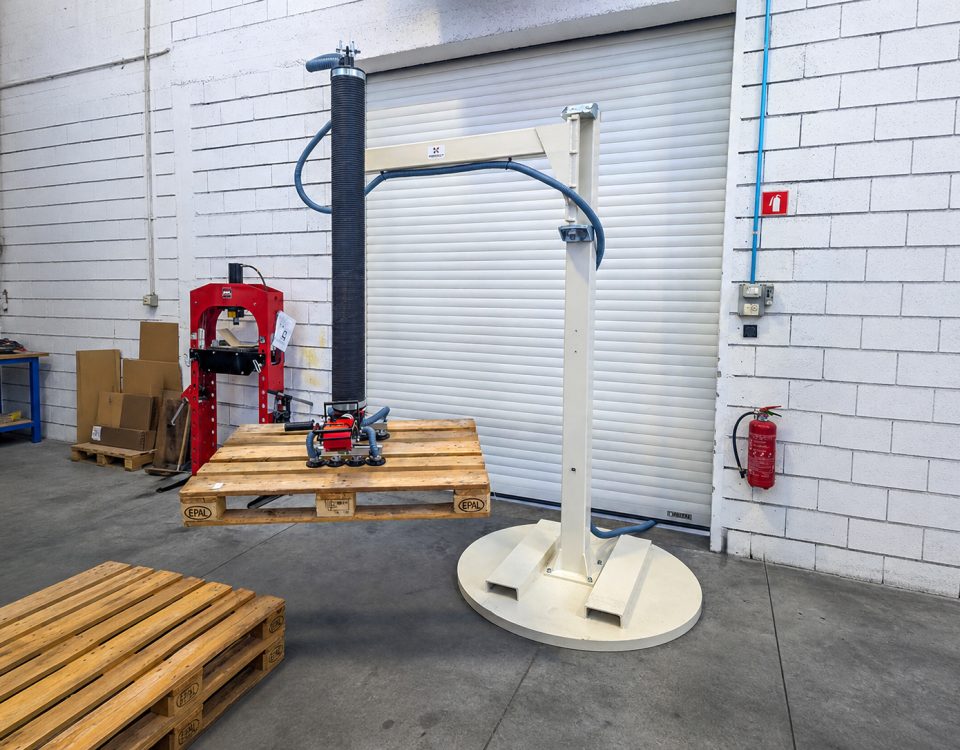
A vacuum tube lifter is not just a mechanical lifting device. It acts as an extension of the operator’s arm. The lifting speed is proportionally controlled by the operator through a responsive control handle or valve. This allows fast vertical movement when speed is needed and slower, more precise positioning when accuracy is required.
Good ergonomic handling means that the speed of the system should match the natural rhythm of the operator and the workflow. With proper training, operators can perform fast, fluid and repeatable movements. In mixed-load environments, this flexibility can be a major advantage compared to fully automated systems that may require more programming, fixed paths or standardized product dimensions.
Balancing High Speed with Workplace Safety
High lifting speed is only valuable if it is achieved safely. In industrial environments, speed must never come at the cost of operator health, load stability or process reliability. A properly designed vacuum tube lifter includes safety features that support fast handling while reducing risk.
One important safety feature is the integrated non-return or check valve. In the event of a power failure or vacuum interruption, the valve helps maintain the vacuum long enough to lower the load in a controlled way. This prevents the load from suddenly dropping from a suspended position.
Another key safety advantage is the design of the suction and release mechanism. The system is engineered so that the operator cannot accidentally release the load while it is suspended in an unsafe condition. The load remains secured until it is safely positioned and ready to be released.
By using vacuum technology, companies can reduce the risk of musculoskeletal injuries caused by fast, repetitive manual lifting. Operators no longer need to carry heavy loads by hand, twist their bodies under weight or perform repeated high-strain movements. This makes vacuum lifting especially valuable in workplaces where productivity and employee safety must be improved at the same time.
Where High-Speed Vacuum Tube Lifters Are Most Useful
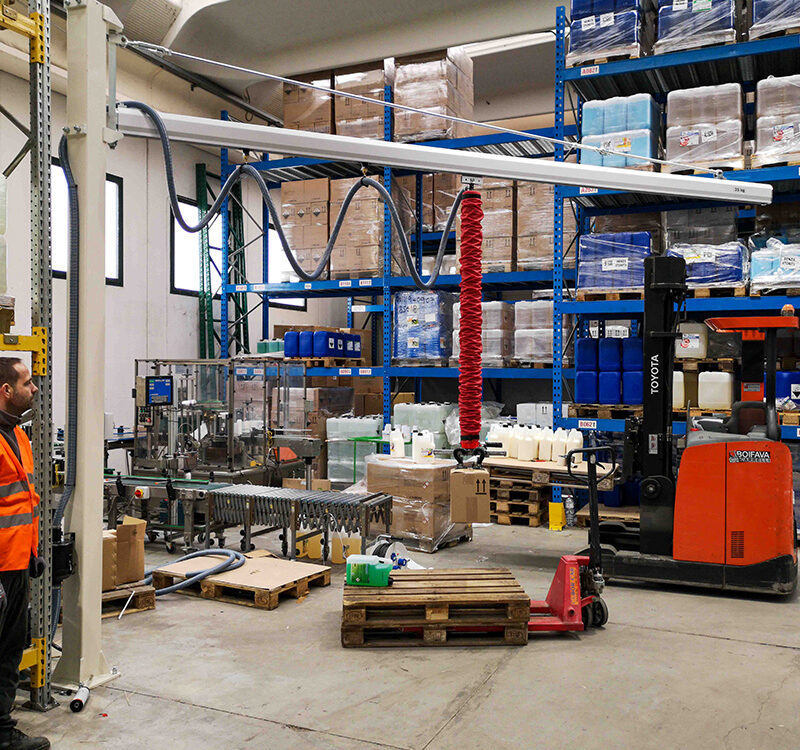
High-speed vacuum tube lifters are particularly useful in applications where operators handle many loads per hour. Typical examples include palletizing cardboard boxes, depalletizing incoming goods, moving bags or sacks, loading production lines, handling panels and transferring products between workstations.
They are also effective in environments where loads vary in size or weight. Because the operator controls the movement directly, the system can adapt quickly to different products without complex adjustments. This makes vacuum tube lifters a practical solution for many B2B operations that need both speed and flexibility.
For companies already using pneumatic manipulators, vacuum tube lifters can complement existing handling systems by providing a fast and ergonomic option for lighter or medium-weight repetitive lifting tasks.
Conclusion: Focus on Throughput, Not Just Speed
When evaluating vacuum tube lifters, it is important to look beyond the maximum vertical lifting speed. While the maximum lifting speed of vacuum tube lifters can reach up to 1 meter per second in optimal conditions, the true business value comes from faster overall cycle times, safer handling and improved operator efficiency.
The right system depends on the load weight, material porosity, lifting height, handling frequency, pump capacity, suction cup design and working environment. Proper sizing of the lifting tube, vacuum pump and gripping system is essential for achieving high speed without compromising safety.
If your facility requires faster material handling, expert evaluation is the best first step. A correctly configured vacuum tube lifter can help improve throughput, reduce physical strain and create a safer, more efficient production or logistics process.
Need to speed up your production line?
Contact Adria Manipulators today for a custom lifting evaluation.
Frequently Asked Questions
Can you adjust the lifting speed of a vacuum tube lifter?
Yes. The lifting speed is adjustable and proportionally controlled by the operator in real time. By pressing or releasing the control valve, the operator can move from fast lifting to slow and precise positioning.
Is a vacuum tube lifter faster than a standard electric chain hoist?
In many practical handling applications, yes. A standard chain hoist usually works at a fixed speed and often requires hooks, slings or additional load preparation. A vacuum tube lifter can lift quickly and grip the load almost instantly, which helps reduce the complete handling cycle.
Does lifting porous boxes reduce the speed of the lifter?
It can, if the system is not properly optimized. Porous cardboard allows air to enter the vacuum system. To maintain high lifting speeds with porous materials, the system should use a suitable high-flow vacuum pump and the correct suction cup design.
What is more important: lifting speed or total cycle time?
Total cycle time is usually more important. The real productivity benefit comes from how quickly the operator can grip, lift, move and release the load safely. Vacuum tube lifters are effective because they improve the entire handling process, not only the vertical lifting movement.
How do you choose the right vacuum tube lifter for high-speed handling?
The right configuration depends on the maximum load weight, surface material, porosity, lifting height, required reach and number of lifts per hour. For high-speed applications, the lifting tube, vacuum pump and suction cup system must be sized according to the real working conditions.
See Our Tube Lifters in Action
Want to see how our vacuum lifters operate in real industrial environments?
Visit our YouTube channel for demo videos, installations, and expert insights.
Ready to Improve Box and Bag Handling?
Contact Adria Manipulators today for a custom lifting evaluation.